Dr. Jeff Sutherland called hybrid Agile a guaranteed failure. Here’s what Malaysian C-suites and PMOs get wrong – and the one thing you can do today to avoid the same fate.
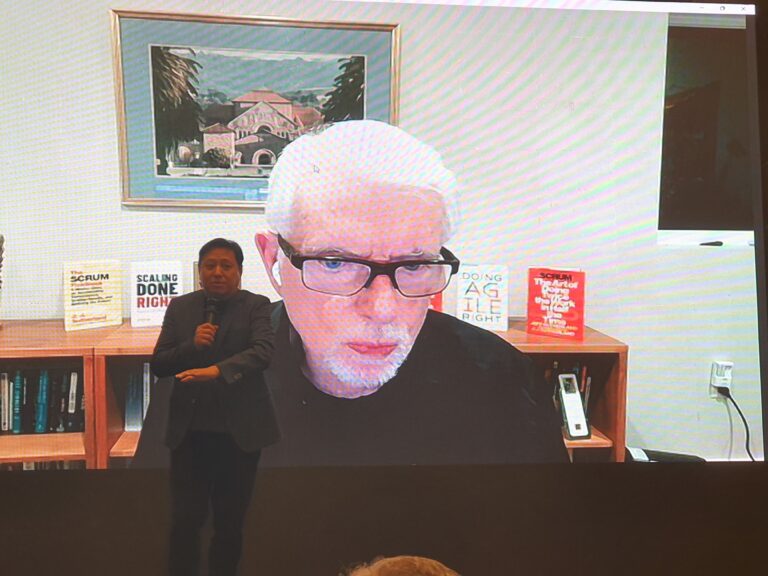
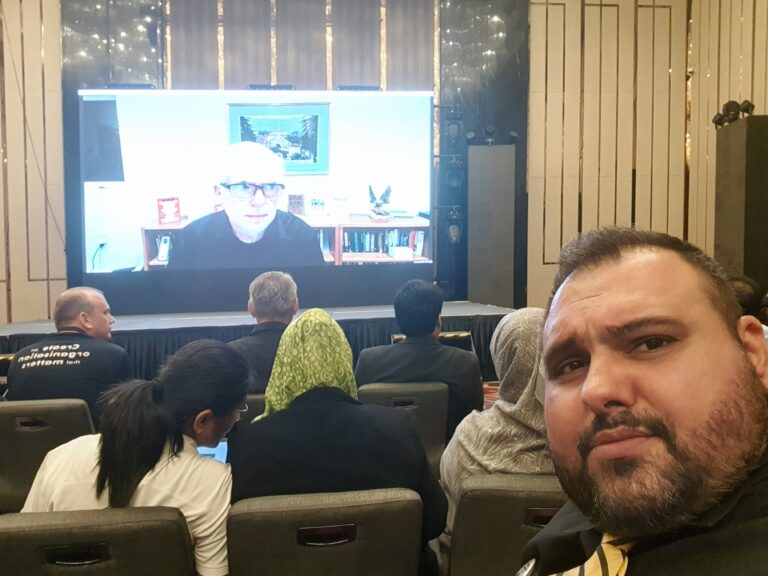
Oct 2023. A live online conference. Dr Jeff Sutherland – the man who invented Scrum – on the big screen. And me, sweating, about to ask a question I knew might sting.
Ethan Soo of CI Agile had organized something special. The Grandmaster himself, presenting his latest weapons: Scrum AI and Scrum@Scale. The room was buzzing.
Then came Q&A.
I raised my hand.
“Sir,” I said, “here in Malaysia, Agile is still growing. Many practitioners struggle to fully embrace it. So they fall back on a hybrid style – part Agile, part Waterfall. What’s your opinion?”
His face tightened. Looked irked, even through the webcam.
Then the answer came. No hesitation. No diplomatic softening.
“They will most certainly fail.”
The room went quiet. I nodded, sat down, and spent the next 18 months watching him be proven right – again and again – inside real Malaysian enterprises.
Here’s what I learned. And why, if you’re a C-suite leader still defending “hybrid” as a safe middle ground, you’re not de-risking anything. You’re building a coffin with two lids.
First, Get Inside Jeff Sutherland’s Head
Dr Sutherland isn’t a consultant. He’s a combat veteran of 1990s software development, when failure rates for large projects sat at 70-80%. Scrum was born from pain – watching smart people fail because their system was broken.
His core belief is simple: Complex work is not linear.
Waterfall assumes you can predict the future. Requirements locked. Design locked. Build locked. Test locked. That works for a bridge. It does NOT work for a digital product, an AI agent, or a customer journey.
Agile – real Scrum – is built on inspect and adapt. Every sprint, you have a potentially shippable increment. Every review, you pivot based on real feedback. Every retrospective, you fix your own engine.
Now, what’s “hybrid” in practice?
It’s usually Waterfall with stand-up meetings. Or Scrum with a six-month “planning phase” upfront. Or two-week sprints with a once-a-year release. Or “we’re Agile” except the PMO demands Gantt charts, phase-gate reviews, and a business case that cannot change.
To Dr Sutherland, that’s not hybrid. That’s organizational schizophrenia.
The look he gave me? That was a man tired of watching teams spend 80% of their energy managing the contradictions between two systems – instead of delivering value.
But Let Me Be Fair. I Sit On Your Side Too.
I’m a Portfolio Manager. I work with C-suites across Malaysia. I understand why you reach for hybrid.
1. “We have fixed budgets and annual planning cycles.” You can’t tell a public company board, “We’ll spend Q1 exploring.” That gets you fired. Hybrid feels like a compromise.
2. “Regulatory compliance.” Banking, healthcare, government. Auditors want evidence of planned vs actual. Waterfall gives a straight line. Agile gives a zigzag. Hybrid? A zigzag that pretends to be straight.
3. “External vendors and fixed-price contracts.” You can’t put a T-shirt size estimate on a statement of work. Procurement teams aren’t ready for time-and-materials.
4. “My PMO needs dependency visibility across 20 projects.” Agile’s pull-based flow scares them. They want a master Gantt.
5. “Cultural fear.” Malaysia isn’t Silicon Valley. Hierarchies exist. “Failure is learning” sounds great until a VP’s bonus depends on hitting a date.
Every single concern is real. Ignore them, and you’re a naive coach. Address them poorly, and you get hybrid.
But here’s the punchline: Hybrid doesn’t solve any of those problems. It conceals them until it’s too late.
Why He Said “Most Certainly Fail”
Let me give you the doom factors I’ve watched kill eight consecutive projects in a Malaysian bank.
1. The Accountability Gap
In pure Scrum, the team owns the sprint goal. One accountable group. One definition of done.
In hybrid, who owns the handoff from the “design phase” to the “sprint phase”? Nobody. The Waterfall side blames Agile for changing requirements. The Agile side blames Waterfall for locking things too early. Each post-mortem said the same thing: “Misalignment between teams.” No. It was the structure itself.
2. Cognitive Overload and Gaming
Developers learn to game the system. They write “100% unit test coverage” in the Waterfall spec, then skip tests during sprints because “we’re Agile now.” Product owners maintain two backlogs: one real (Agile), one fake (for PMO reporting).
In one telco transformation I led, hybrid teams spent 35% of sprint capacity just reconciling Waterfall artifacts with Agile boards. Thirty-five percent.
3. The Feedback Loop Is Destroyed
Agile’s superpower is a tight loop: build → measure → learn → adjust.
Hybrid inserts Waterfall gates before and after. “We’ll do discovery (Waterfall), then three sprints (Agile), then a hardening phase (Waterfall).”
What happens when discovery missed something? You find it in sprint 2. But you can’t change the Waterfall gate. So you either fail silently or escalate to a change request that takes six weeks. The loop is broken.
4. Governance Theater
Worst of all: hybrid creates false confidence. The PMO sees a Gantt with “sprint 1, sprint 2” written on it and says, “Great, we’re Agile.” But actual delivery slips. Because no one measured cycle time, lead time, or predictability.
I have literally seen a Scrum Master manually adjust a burndown chart to “match the Waterfall baseline.” That’s not hybrid. That’s fraud.
Sutherland’s “fail” isn’t a curse. It’s a prediction based on systems theory. You cannot run a complex adaptive system with a deterministic, phase-gate control system. They fight. The deterministic side always wins on paper. The adaptive side always wins on reality. And the gap becomes a black hole for money and morale.
So What Do We Do? Burn the PMO? Fire All Project Managers?
No.
I sit in your chair. Here’s my honest advice.
Stop calling it hybrid. Call it what it is: Waterfall with Agile decorations. Then make a real choice.
Option 1: Pure Waterfall – if your work is truly predictable, requirements fixed, change unacceptable. Infrastructure. Hardware. Compliance-mandated reporting. No shame. Just be honest.
Option 2: Pure Scrum (or Scrum@Scale) – if you face complexity, uncertainty, or fast-moving markets. Invest in real training. Kill phase gates. Change your funding model from project to product. Yes, it’s hard. But hybrids are harder.
Option 3: The only defensible “hybrid” – Waterfall for compliance-mandated documentation, but completely decoupled from sprint execution. No handoff dependencies. Two parallel systems that never touch. Rare, but possible.
But the most common hybrid – the one I asked Jeff Sutherland about – is death by a thousand compromises. It fails because it asks people to serve two masters.
And as the Grandmaster knows, you cannot serve two masters.
One Final Thing. The Human Moment.
After his answer, I stayed back in my seat – physically in the forum hall, his face still on the big screen. I didn’t get a private chat. But I watched him carefully.
He wasn’t angry at me. He was impatient – in the way a surgeon gets impatient when you ask, “Can I just stitch this wound with dental floss?”
He has seen the data. He has watched companies burn half a billion dollars on “Agile transformations” that were really just Waterfall with new T-shirts. He invented Scrum because Waterfall failed him.
So here’s my ask, Senior Leader:
Next time someone suggests “hybrid to be safe,” ask them one question:
“What specific problem are we solving by keeping the Waterfall elements?”
If the answer is “governance comfort” or “fear of change” – you already know the outcome.
If the answer is a genuine regulatory or hardware constraint – fine. But then don’t call it Agile. Call it “Waterfall with Agile sprinkles.” And set expectations accordingly.
Because Jeff Sutherland’s words are still echoing in my head, years later:
“They will most certainly fail.”
He wasn’t being cruel. He was being clear.
Let’s stop failing together.
Coach ROAR
Strategic Agile, Gen AI & Digital & Web X.0 Transformation Leader & Advisor
Kuala Lumpur, Malaysia
P.S. – If you were in that room in Oct 2023 watching that live feed, comment below. Let’s keep this conversation real. No hybrid apologies. 😉
Leave a Reply
You must be logged in to post a comment.