by Coach ROAR @ Roshan Singh Malli
Strategic Agile, Gen AI, Digital & Web X.0 Business Transformation Leader & Advisor | Kuala Lumpur, Malaysia
The Football Club That No One Wanted to Coach
Why Agile in Asia keeps failing — and the one thing every leader at every level must stop avoiding
Picture a football club in Kuala Lumpur. Talented players. A decent budget. Genuine ambition. They announce, with considerable fanfare, that they are adopting a new high-performance system. New training philosophy. New language. New playbooks. The players are trained, the captain is briefed, and on match day, the coach sits in the VIP lounge scrolling through reports while the board watches from a private box, waiting for results.
The team loses 4–0.
Sounds like an absurd way to run a football club. Yet this is precisely how many Asian organisations are attempting Agile transformation today — and then blaming the methodology when the season ends in disappointment.
Agile does not fail because the ceremonies are wrong. It fails because the organisation treats it as a player-level initiative while the coaches and the board carry on exactly as before. And that structural misalignment, regardless of how many Scrum certificates hang on the wall, will quietly guarantee failure every single time.
Know Your Position on the Pitch
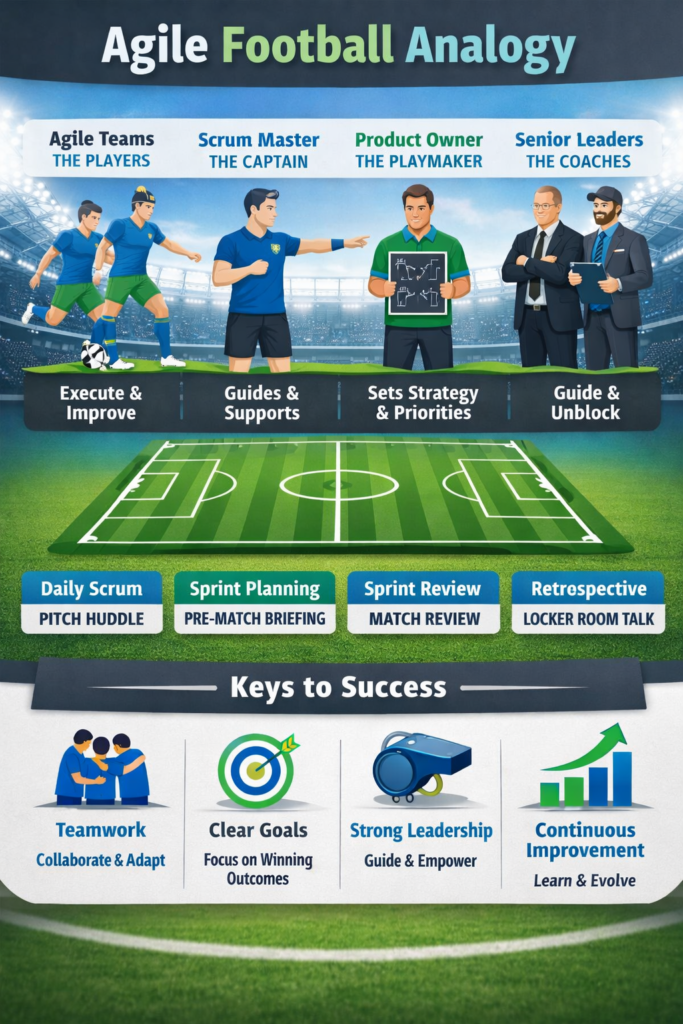
Before a club can win, every person must understand their role — not in theory, but in practice, under pressure, when the clock is running.
| Role | Who They Are & What They Own |
| The Players | Your cross-functional Agile teams — developers, testers, designers, analysts. They own execution. They pass, adapt, and score. They do not wait for permission to make a forward run. |
| The Captain | Your Scrum Master. On the pitch, in the mud with the team. Their job is not to direct play — it is to keep morale intact, remove friction, and shield the squad from noise coming off the bench. |
| The Playmaker | Your Product Owner. The midfield general who reads the entire pitch, prioritises the next move, and decides where the ball goes to maximise value. They own the backlog. They say no more than they say yes. |
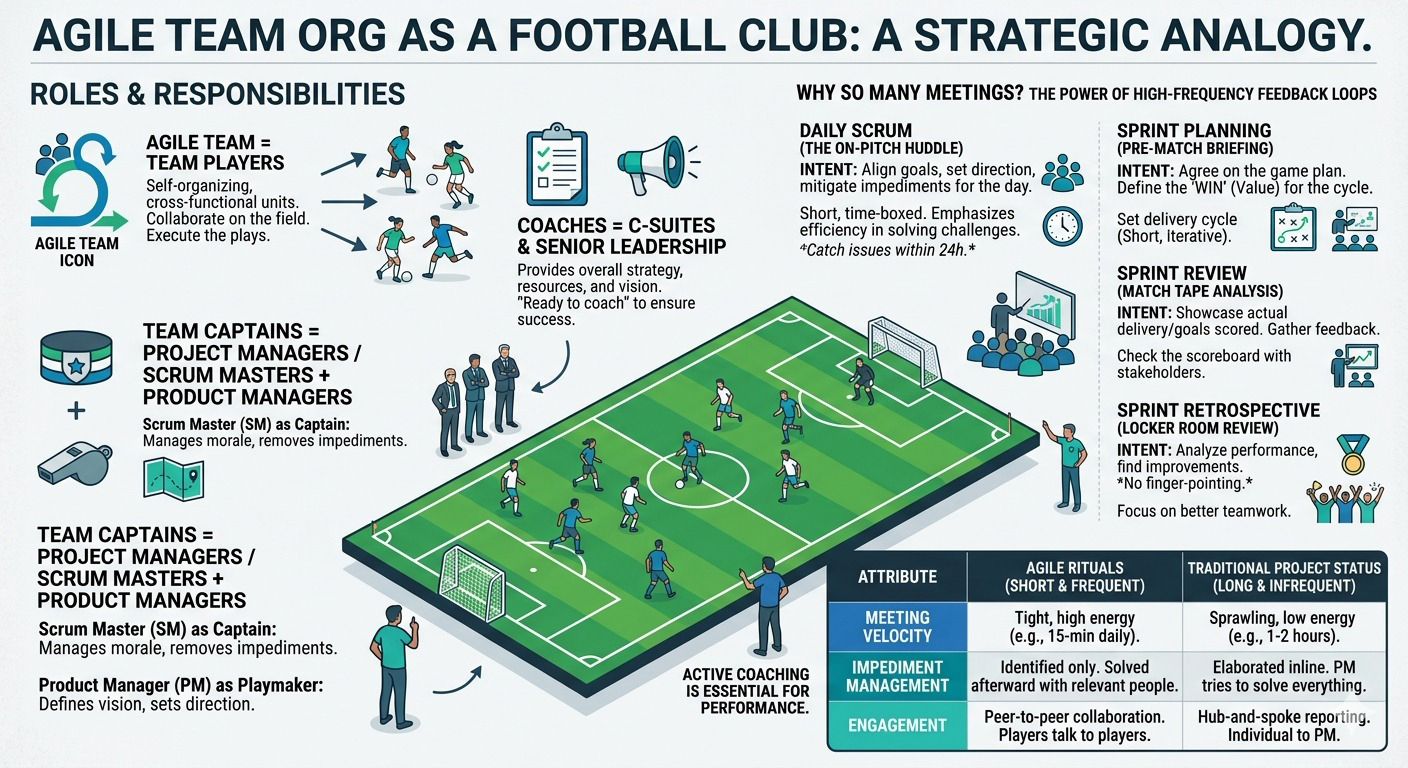
| The Coach | Your C-Suite and Senior Leaders. Your job is strategy, not tactics. You design the formation, you study the competition, you substitute when the system is broken. You do not run onto the pitch. Not ever. |
| The Board | Your Steering Committee and Executive Sponsors. You set the league position — the OKRs. You fund the squad. You create the conditions for winning. You do not decide which pass to make on Tuesday afternoon. |
Misassign any one of these roles and you produce the most common — and most expensive — dysfunction in Asian organisations: the leader who bought Agile but kept managing like it was 2008.
“Why Does Agile Have So Many Meetings?”
This is the question every senior leader asks within three weeks of an Agile rollout. It is also, with respect, the wrong question.
The better question is: what are your current meetings actually producing?
A traditional project status meeting is a backward-looking instrument. By the time a risk appears on a slide deck in a steering committee, it has already cost the team days — sometimes weeks — of blocked progress. You are not being kept informed. You are being narrated at, about events you can no longer influence.
Agile ceremonies are something different entirely. They are time-boxed, forward-looking tactical huddles. Each one has a single purpose, a hard time limit, and a defined output.
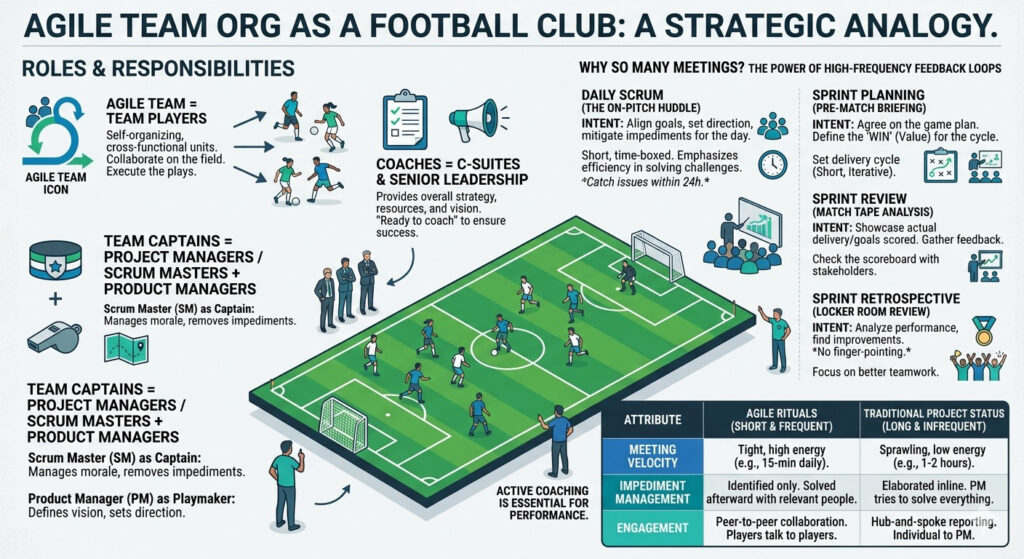
| Ceremony | The Football Equivalent | What It Actually Does |
| Sprint Planning | The night-before match briefing. | Team commits to a realistic goal for the next two weeks. No ambiguity about what winning looks like. |
| Daily Scrum | The 15-minute pre-training huddle. | Not a report to management. Players align with each other: what are we focused on today, and what is in the way? |
| Sprint Review | Post-match with the fans. | Show working product — not slides about working product. Take honest feedback. Adapt. |
| Retrospective | Locker room after the final whistle. | Safe, honest, solution-focused. How do we pass cleaner, communicate faster, and perform better next time? |
A full two-week sprint cycle runs fewer total meeting hours than a single traditional project steering committee. The difference is not volume — it is direction. Short, frequent, forward-looking loops beat long, infrequent, backward-looking reports. In sport and in business, the team that loops through observing, deciding, and acting fastest wins.
The Coaching Failure No One Talks About
Let me be direct, because this is where Asian Agile transformations most often collapse.
There are two failure modes for leaders, and both destroy teams.
Failure Mode One: The Invisible Coach. The leader announces Agile, attends the launch event, and disappears. The team is left to self-organise without strategic air cover. No impediment removal. No priority calls. No protection from organisational politics. The team burns out, becomes cynical, and Agile gets blamed. In football terms: the coach told the players to go win, then sat in the car park for ninety minutes.
Failure Mode Two: The Micromanager. The leader attends every ceremony, overrides sprint priorities mid-cycle, demands detailed status slides that contradict the working software just demonstrated, and runs onto the pitch to kick the ball. The team stops thinking. Autonomy evaporates. Agile becomes theatre — the rituals continue, but the mindset is gone.
The right posture sits between these two extremes, and it requires genuine discipline. Before the sprint: set the system of play — the quality standards, the definition of done, the strategic priorities. During the sprint: remove obstacles. Unblock dependencies. Protect the team from noise. Do not rewrite the backlog. After the sprint: ask what you learned, not who made a mistake.
That is not soft leadership. That is how championships are won.
The Asian Context: Why This Matters Now
Agile is still maturing in Asia. Many organisations carry deep cultural habits — hierarchy as respect, consensus over speed, status reporting as governance. These are not weaknesses. They are context. And Agile, implemented without acknowledging this context, will produce resistance rather than results.
The football analogy works precisely because sport is universally understood. Every Asian who has watched a match knows that a team of individuals playing for personal statistics does not win trophies. They know that a coach who never speaks to the players breeds confusion. They know that a board that changes the formation every match poisons team confidence.
They already know what good looks like. They just have not seen it labelled as Agile before.
The opportunity for Asian organisations is not to copy Silicon Valley. It is to find the version of high-performance agility that fits their culture, their industry, and their stage of growth — and then commit to it with the same discipline a great football club commits to its identity.
What This Demands of Every Level
Players — Agile Teams: Own your execution. Speak up early when something is broken. Raise impediments in the Daily Scrum, not in a private message to your manager three days later. Your autonomy is a tool — use it with accountability.
Captains and Playmakers — Scrum Masters and Product Owners: Hold the line on priorities. Protect the team from scope creep. Run retrospectives that produce action, not venting. Your role exists to make the team faster and more focused — measure yourself against that.
Coaches — Senior Leaders and C-Suite: The single most important thing you can do for your Agile transformation is change the question you ask at the end of a sprint. Stop asking, “What did you do?” Start asking, “What is stopping you?” That shift alone will change your culture more than any training programme ever will.
The Final Whistle
I once asked a Head of Product who had cancelled his retrospectives to save time: “If your team conceded three goals in the first half, would you skip the locker room talk?”
He went quiet. Then he laughed. Then he fixed his sprint cadence.
You are the coach. Your team is on the pitch. The league table is your product roadmap and your quarterly OKRs.
The trophy does not go to the organisation with the most Agile certifications. It goes to the one where leaders at every level — players, captains, coaches, and board — show up, play their position with integrity, and genuinely commit to getting better after every single match.
Stop watching from the VIP lounge. Get on the sideline. Let your teams play — and coach them like you actually want to win.
Leave a Reply
You must be logged in to post a comment.